40001-95522
 sctk-yybgs@tkhealthcare.com40001-95522
sctk-yybgs@tkhealthcare.com
sctk-yybgs@tkhealthcare.com40001-95522
sctk-yybgs@tkhealthcare.com
WeChat Official
Internet Hospital

Online Shopping Mall

Sina Weibo
15 April 2026
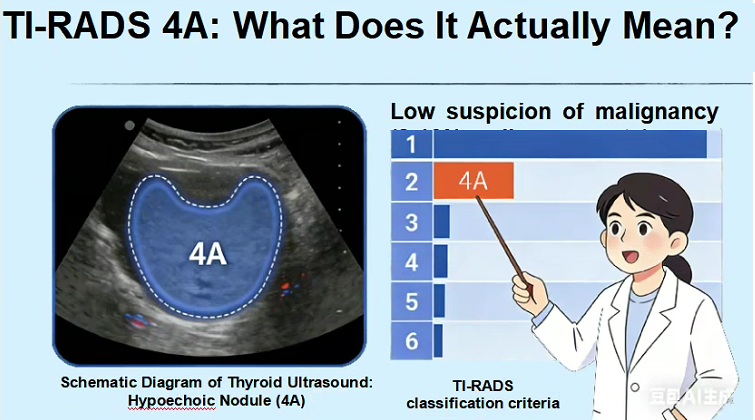
Image source: AI-generated, for educational purposes only
When the words "Thyroid nodule, TI-RADS 4A category" appear on a physical examination report, many people's first reaction is worry or even fear—"Is it cancer?"
"Do I need surgery?" "What should I do?"
In fact, 4A is not frightening, and a scientific approach is key.
I. First, understand TI-RADS 4A: What does it really mean?
"TI-RADS" is the English abbreviation for Thyroid Imaging Reporting and Data System, a tool used by ultrasound doctors to standardize the description and risk assessment of thyroid nodules.
It scores and grades nodules based on their ultrasound features (such as morphology, margin, echo, and Calcification).
· Categories 1-3: Usually benign or with very low suspicion, with a malignancy risk of <5%. Regular observation is generally recommended.
· Category 4: Suspicious for malignancy, and further subdivided into:
· 4A (low suspicion): Malignancy risk of 2%-10%. This means there is a 90%-98% probability that it is benign.
· 4B (moderate suspicion): Malignancy risk of approximately 10%-50%.
· 4C (high suspicion): Malignancy risk of approximately 50%-85%.
· 5 category: Highly suggestive of malignancy, risk >85%.
· 6 category: Malignant nodule confirmed by biopsy.
Key takeaway:
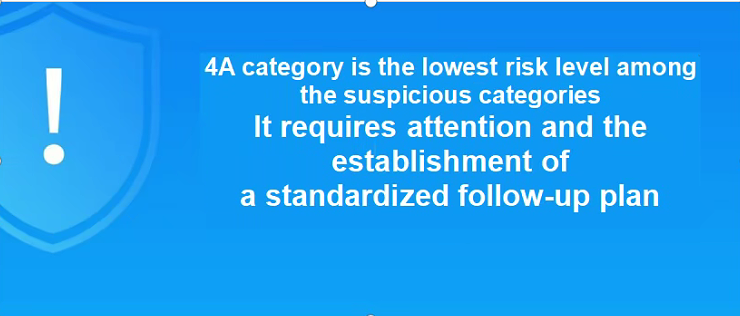
Image source: Self-produced with authorization from our hospital's member account
二、Why do thyroid nodules occur?
Thyroid nodules are quite common. With the widespread use of high-resolution ultrasound, detection rates in the general population can range from 20% to 70%, with the vast majority (approximately 90%-95%) being benign.
The development of nodules is influenced by various factors, so there's no need to blame ourselves for it.
· Genetic factors: Individuals with a familial history of thyroid disorders are at a marginally elevated risk.
· Iodine Intake: Prolonged insufficient or excessive iodine intake may be associated with the formation of nodules.
· Hormone Levels: The incidence rate among women is significantly higher than that among men, indicating a potential correlation with estrogen levels.
· Radiation History: A documented history of radiation exposure to the head and neck region during childhood constitutes a significant risk factor.
· Autoimmunity: For instance, Hashimoto's thyroiditis is frequently associated with the presence of nodules.
· Others: Emotional stress, lifestyle, etc., may also have a certain impact.
III. What should I do after a TI-RADS 4A nodule is found?
After discovering a nodule, it's important not to panic or seek medical attention indiscriminately, but also not to ignore it.
Please follow the scientific path of "Assessment-Monitoring-Decision Making".
Step 1: Initial assessment and further examinations
1. Visit a specialist with your report: It is recommended to consult the Endocrinology Department or the Department of Otorhinolaryngology Head and Neck Surgery.
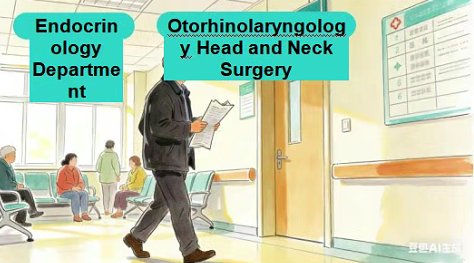
Image source: AI-generated, for educational purposes only
2. Comprehensive assessment by a doctor: The doctor will not only look at the ultrasound report but also make a comprehensive judgment based on your age, gender, any history of radiation, nodule size, presence of compression symptoms (such as a foreign body sensation when swallowing, difficulty breathing, etc.), and the results of thyroid function blood tests (such as TSH, T3, T4, etc.).
Step 2: Decide whether FNA (Thyroid fine needle aspiration biopsy) is needed
This is the "gold standard" for determining whether a nodule is benign or malignant, but not all TI-RADS 4A nodules need an immediate biopsy.
· Biopsy is usually recommended in the following cases: The nodule diameter is >1cm; or although it is <1cm, it is accompanied by Ultrasound high-risk features (such as Ill-defined margins, Hypoechoic, microcalcification, etc.), a history of head and neck radiation, or a family history of Thyroid cancer.
· Cases where observation may suffice: The nodule is small (e.g., <0.5cm), the ultrasound features are not typical, and there are no risk factors. The doctor may recommend "Active surveillance," which means regular follow-up.
Step 3: Develop a long-term follow-up plan
If the evaluation suggests that a biopsy is not necessary at this time, or if the biopsy results are benign, consistent follow-up remains essential.
· Follow-up frequency: A thyroid ultrasound is typically recommended every 6 to 12 months.
· Follow-up content: The primary goal is to monitor and assess any changes in the nodule's size, shape, edges, and internal structure. Stable benign nodules can remain harmless for an extended period.
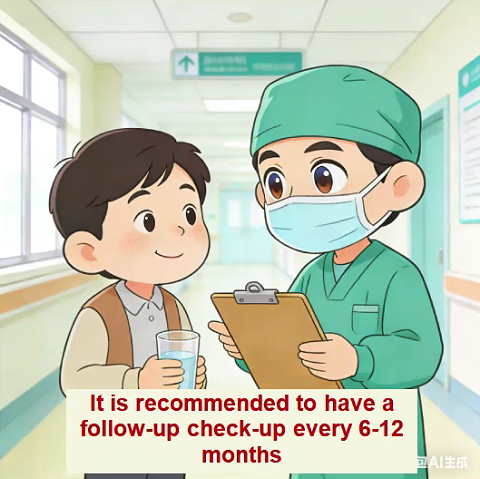
Image source: AI-generated, for educational purposes only
Step 4: Seize the timing for intervention
Surgery or other treatments should only be considered when the following situations occur:
1. A percutaneous biopsy confirms or strongly suggests malignancy.
2. During follow-up, if the nodule volume increases by more than 50% or new suspicious ultrasound features emerge, it should be noted.
3. The nodule is large (typically >3-4cm), leading to compression symptoms or impacting appearance.
4. The nodule is situated behind the sternum, which may pose a risk of compression.
IV. Besides seeing a doctor, what should I pay attention to in my daily life?
1. Stay calm: Anxiety and excessive stress may affect the endocrine system. Please trust that with most TI-RADS 4A nodules, you have plenty of time for observation and decision-making.
2. Maintain a balanced diet:
· Regarding "iodine": Unless your doctor has clearly diagnosed you with a disease that requires strict iodine control (such as Hyperthyroidism), you only need to consume Iodized salt normally. Avoid consuming ultra-high iodine foods like kelp and nori in large quantities over an extended period. There's no need to worry excessively about seafood; regular amounts and servings of seafood and sea fish are perfectly fine.
· Balanced nutrition: Ensure the intake of high-quality protein and vitamins, and include more fresh fruits and vegetables in your diet.
3. Maintain healthy lifestyle habits: Avoid smoking and staying up late. Keep up with regular exercise to boost your immune system.
4. Exercise caution with neck exposure: Refrain from unnecessary neck radiographic examinations.
5. Learn to self-observe: Occasionally feel your neck for any noticeably enlarged lumps, hoarseness, or difficulties with swallowing or breathing. If you notice any changes, seek medical attention promptly.
V. Clarifying common misconceptions about thyroid nodules!
· Misconception 1: Thyroid nodule = Thyroid cancer. Wrong! The vast majority of nodules are noncancerous.
· Misconception 2: The smaller the nodule, the safer it is. Not necessarily. There is no definitive correlation between benign or malignant status and size; even a microscopic carcinoma can be extremely small. Ultrasound features are key.
· Misconception 3: Traditional Chinese Medicine and health supplements can "eliminate nodules." Currently, there is no solid evidence to suggest that any medication or health supplement can effectively eliminate benign thyroid nodules. Taking them without discretion may actually put more strain on the liver.
· Myth 4: A TI-RADS 4A nodule must be surgically removed immediately. This is the biggest misconception! For low-risk TI-RADS 4A nodules, the risks associated with overtreatment (unnecessary surgery), such as hoarseness, hypothyroidism, and lifetime medication, may far outweigh the risks of the nodule itself.
Finally, please remember these three key recommendations:
1. Face it calmly: TI-RADS 4A thyroid nodules are very common. It is a "reminder" in health management, not a "verdict."
2. Trust the professionals: Leave professional matters to professional doctors. Please be sure to visit a regular medical institution, communicate fully with your doctor, and jointly develop an individualized management plan that is most suitable for you.
3. Adhere to follow-up: Regular ultrasound follow-up is the safest and most important line of defense in managing thyroid nodules. Please make sure to regularly update your doctor on the status of your nodule, just like you would check in with an old friend.
Scientific understanding is the best way to dispel fear. Standardized management serves as the strongest safeguard for health. May you approach it with grace and embrace a peaceful life from this moment forward!
Contributed by: Zhang Menglin, Health Management Center

Service Hotline:40001-95522-3
24Hour Consultation Hotline:028-66831111
24Hour Emergency Hotline:028-66831120

WeChat Official