40001-95522
 sctk-yybgs@tkhealthcare.com40001-95522
sctk-yybgs@tkhealthcare.com
sctk-yybgs@tkhealthcare.com40001-95522
sctk-yybgs@tkhealthcare.com
WeChat Official

Internet Hospital

Online Shopping Mall

Sina Weibo
15 April 2026
The Department of Nuclear Medicine at Sichuan Taikang Hospital has successfully introduced Prostate-Specific Membrane Antigen (PSMA) PET/CT imaging technology, officially integrating this advanced technique, highly esteemed in prostate cancer diagnosis and treatment, into clinical practice. With its exceptionally high target specificity, this technology addresses the limitations of traditional diagnostic and treatment methods, particularly in detecting microscopic lesions and monitoring recurrence. It offers prostate cancer patients comprehensive precision medical services throughout the entire cycle, from early diagnosis to efficacy evaluation, thereby enabling the hospital to achieve a significant advancement in urological oncology diagnosis and treatment.
Prostate cancer, a common malignant tumor in men, presents with insidious early symptoms. Traditional CT and MRI scans often struggle to accurately differentiate the nature of lesions and have limited detection rates for microscopic lesions, such as bone metastasis and lymph node metastasis. This often results in some patients missing the optimal treatment window.
The development of 18F-PSMA PET/CT imaging technology has effectively resolved this challenge. Prostate-specific membrane antigen is highly expressed on the surface of prostate cancer cells, with its expression level positively correlated with the degree of tumor malignancy, while it is almost unexpressed in normal tissues. After intravenous administration, the 18F-PSMA imaging agent precisely targets and binds to antigens on the surface of tumor cells, enabling clear visualization of primary tumors, metastatic lesions, and occult recurrent lesions on images, thereby achieving "lesion visualization."

Image source: Taikang Media Resource Library.
In its initial phase of application, the technology has already delivered precision medicine plans to patients.
Case presentation:
An elderly male with a history of benign prostatic hyperplasia presented with a left neck mass that had been present for many years, along with dysuria and urinary stream splitting for 5 years, as well as hematospermia, raising suspicion of a prostate tumor. The PET/CT images are shown below. The first row displays the CT images, while the second row presents the fusion images and MIP images, respectively.
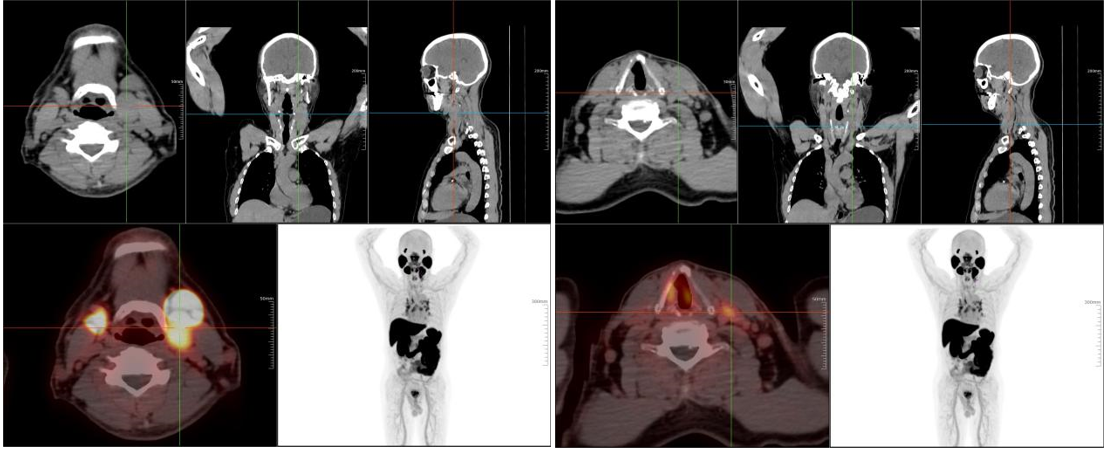
Enlarged lymph node shadows are observed in the left neck, posterior-inferior to the submandibular gland, within the mediastinum (2R, 4R, 4L, 5, 6, 7, 8), and in both hila. The largest lymph node, located in the left neck, has a maximum cross-section of approximately 28.5mm x 20.0mm and shows increased radioactive uptake with an SUVmax of 6.80. The left submandibular gland is compressed and displaced. These findings suggest lymph node metastasis, and a biopsy pathology examination is recommended.
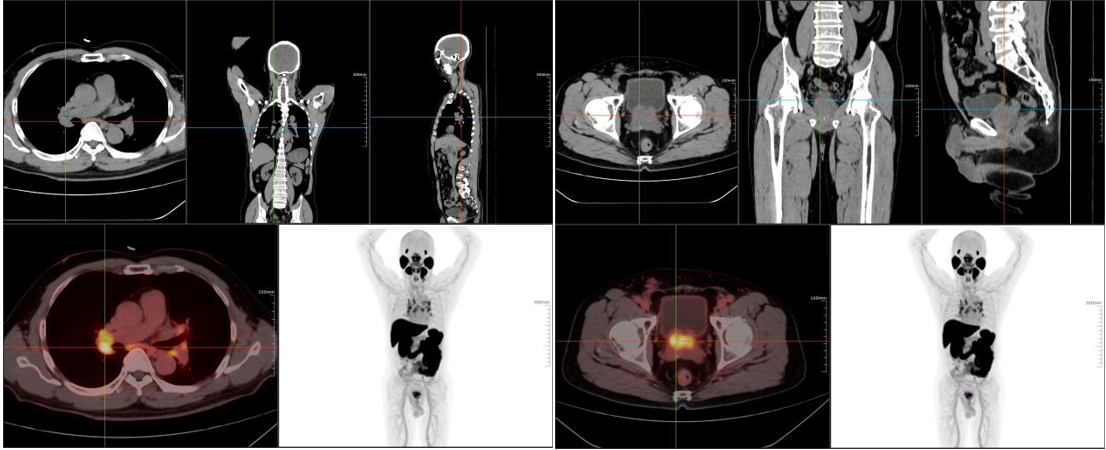
The prostate is enlarged and protrudes superiorly into the bladder, exhibiting non-uniform density. The maximum transverse diameter is approximately 55.3 mm, and the anteroposterior diameter is approximately 42.5 mm. Punctate and linear high-density shadows are observed within the gland. There is localized increased radioactive uptake, mainly in the central and peripheral zones of the gland, with the area of increased uptake measuring approximately 38.1 mm x 27.3 mm and an SUVmax of 7.09. The prostatic capsule appears slightly irregular in certain areas. Prostate cancer is considered, and tumor extension beyond the capsule cannot be ruled out.
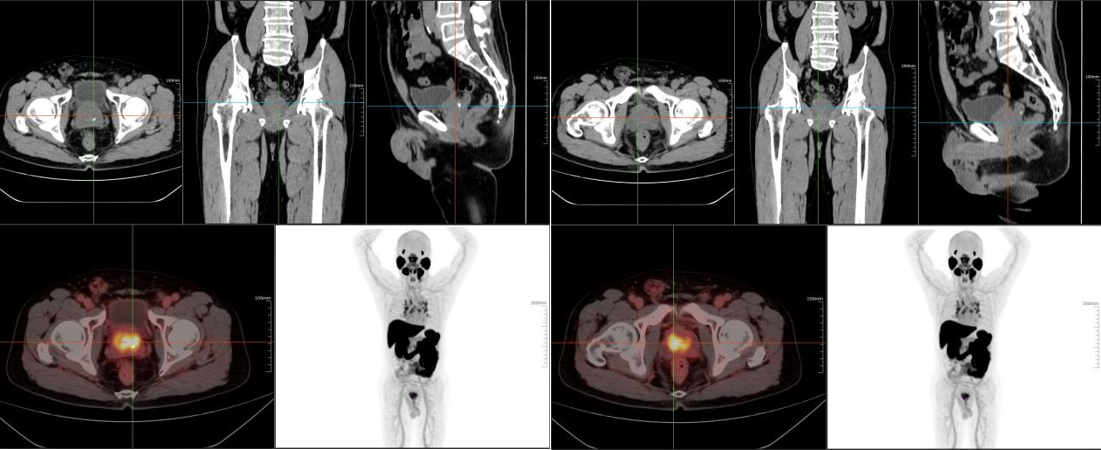
PSMA PET/CT imaging accurately identified the hidden metastatic lesions, enabling clinicians to promptly adjust the biopsy site and treatment strategy.
"The adoption of PSMA imaging technology for prostate cancer enhances our department's precision medicine capabilities while aligning with the prevailing trend of individualized tumor treatment." Yuan Gengbiao, Director of the Department of Nuclear Medicine at Sichuan Taikang Hospital, stated that the department will continue to enhance the clinical application of this technology. They will conduct specialized research by combining PSMA imaging with AI image diagnosis and share technical experience and clinical practice guidelines through the Nuclear Medicine New Technology Innovation Alliance to benefit more prostate cancer patients.
Contributed by: Wang Jinyu and Shi Yunpeng
Reviewed by: Yuan Gengbiao

Service Hotline:40001-95522-3
24Hour Consultation Hotline:028-66831111
24Hour Emergency Hotline:028-66831120

WeChat Official